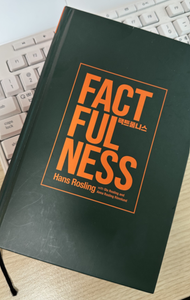
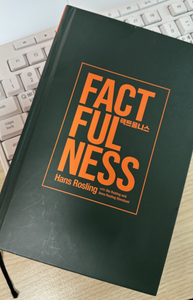
Book Title: Factfulness: Ten Reasons We’re Wrong About the World—and Why Things Are Better Than You Think
Authors: Hans Rosling, Ola Rosling, Anna Rosling Rönnlund

How objectively have I been looking at the world?
This was the first question that came to mind while reading Factfulness by Hans Rosling.
I had always believed that I made reasonably rational decisions based on my knowledge and experiences. However, as I continued reading, I realized that many of my beliefs were not necessarily based on facts.
Rather than simply summarizing the book, I wanted to use this Factfulness book review as an opportunity to reflect on my own thoughts, biases, and habits of judgment.
The 10 Instincts That Distort Our View of the World
In Factfulness, Hans Rosling introduces 10 human instincts that can prevent us from seeing the world as it really is.
These are the Gap Instinct, Negativity Instinct, Straight Line Instinct, Fear Instinct, Size Instinct, Generalization Instinct, Destiny Instinct, Single Perspective Instinct, Blame Instinct, and Urgency Instinct.
At first, I assumed that everyone was influenced by at least some of these instincts. However, as I read through the book, I began to recognize how strongly several of them affected my own thinking.
I realized that I often relied on existing assumptions rather than carefully examining the facts. This reflected the Gap Instinct.
I also recognized the Negativity Instinct in myself. Constant exposure to negative news had led me to believe that the world was still full of problems and that many low-income countries had made little progress.
The Straight Line Instinct appeared in my tendency to assume that current situations would continue in the same direction. Similarly, the Fear Instinct was reflected in my habit of worrying excessively about things that had not even happened.
The Single Perspective Instinct was particularly thought-provoking. I realized how often I interpreted the world through the limited lens of my own knowledge and experiences.
It made me wonder whether I had been living like a frog in a well, unaware of how much existed beyond my familiar surroundings.
The Blame Instinct and Urgency Instinct That Resonated with Me Most
Among the 10 instincts described in Factfulness, the Blame Instinct left the strongest impression on me.
Whenever something went wrong, I often blamed myself instead of objectively examining the different factors that might have contributed to the problem.
In the book, the Blame Instinct refers to our tendency to look for someone or something to hold responsible for a problem. However, it also made me reflect on my personal habit of being overly critical of myself.
Acknowledging my mistakes and learning from them is important. Nevertheless, assuming that every problem is entirely my fault is not an objective way of understanding a situation.
The Urgency Instinct was another concept I strongly related to.
I had always considered myself someone who tended to act quickly. However, reading this chapter helped me realize that I sometimes rushed into decisions without taking enough time to think carefully or verify the facts.
There are certainly situations that require quick decisions. Yet I came to understand that, especially when facing important choices, it may be better to step back and examine the situation calmly before acting.
What I Learned from Reading Factfulness
To overcome these 10 instincts, the authors present practical rules for developing a more fact-based understanding of the world.
Among them, several ideas stood out to me: consider proportions, use multiple perspectives, resist the temptation to assign blame, and take things one step at a time.
I believe the central message of Factfulness is the importance of looking at the world through facts and data rather than relying solely on personal experiences, emotions, or assumptions.
Of course, I do not expect my long-established habits and ways of thinking to change overnight simply because I have read one book.
However, I believe meaningful change can begin by recognizing that what I think I know may not always be true.
If I continue reminding myself to question my assumptions and verify the facts before making judgments, I hope to gradually develop a broader and more objective perspective.
Factfulness was meaningful to me not only because it helped me gain a better understanding of the world, but also because it encouraged me to reflect on my own biases and the way I make decisions.
My One-Line Review
“To understand the world more accurately, I must first learn to recognize and question my own biases.”